7 min read
Published: November 19, 2026
Contents
- 1.
- 2.
- 3.
Kick my seat and we have a problem: how men, women, and every age really behave at 35,000 feet
The holiday travel rush is almost here, and it’s arriving on the heels of one of the roughest stretches for air travel in recent memory. The nationwide ground stop on November 13 canceled more than 12,000 flights, leaving travelers stranded, and flight crews working overtime to rebook passengers, reroute flights and keep frustrated travelers calm.
On top of this, the holiday travel season comes with the usual crowds, packed overhead bins, and an increase in first-time and infrequent travelers, so patience will be running especially thin. With this in mind, we thought we’d look at how frequent travelers (point.me members, more than half of whom fly five or more times a year) feel about in-flight cabin etiquette. Should you give up your seat so a family can sit together? Does your crying baby really annoy everyone on the plane? What's the one in-flight offense that pushes travelers over the edge? And do men and women actually play by different rules when it comes to airplane etiquette?
Our hope is that a little insight makes us all a bit more understanding of the stranger in the next seat, and appreciative of the crew working the aisle.
As it turns out, the answers aren't always so straightforward. They might shift depending on whether you're a 22-year-old man or a 70-year-old woman. From surprising generational divides to some seriously strong opinions on seat swapping, the results reveal what your fellow passengers might be thinking (but aren't saying) at 35,000 feet.
Consider this your unofficial guide to surviving holiday travel.
Men are more willing to speak up about cabin annoyances
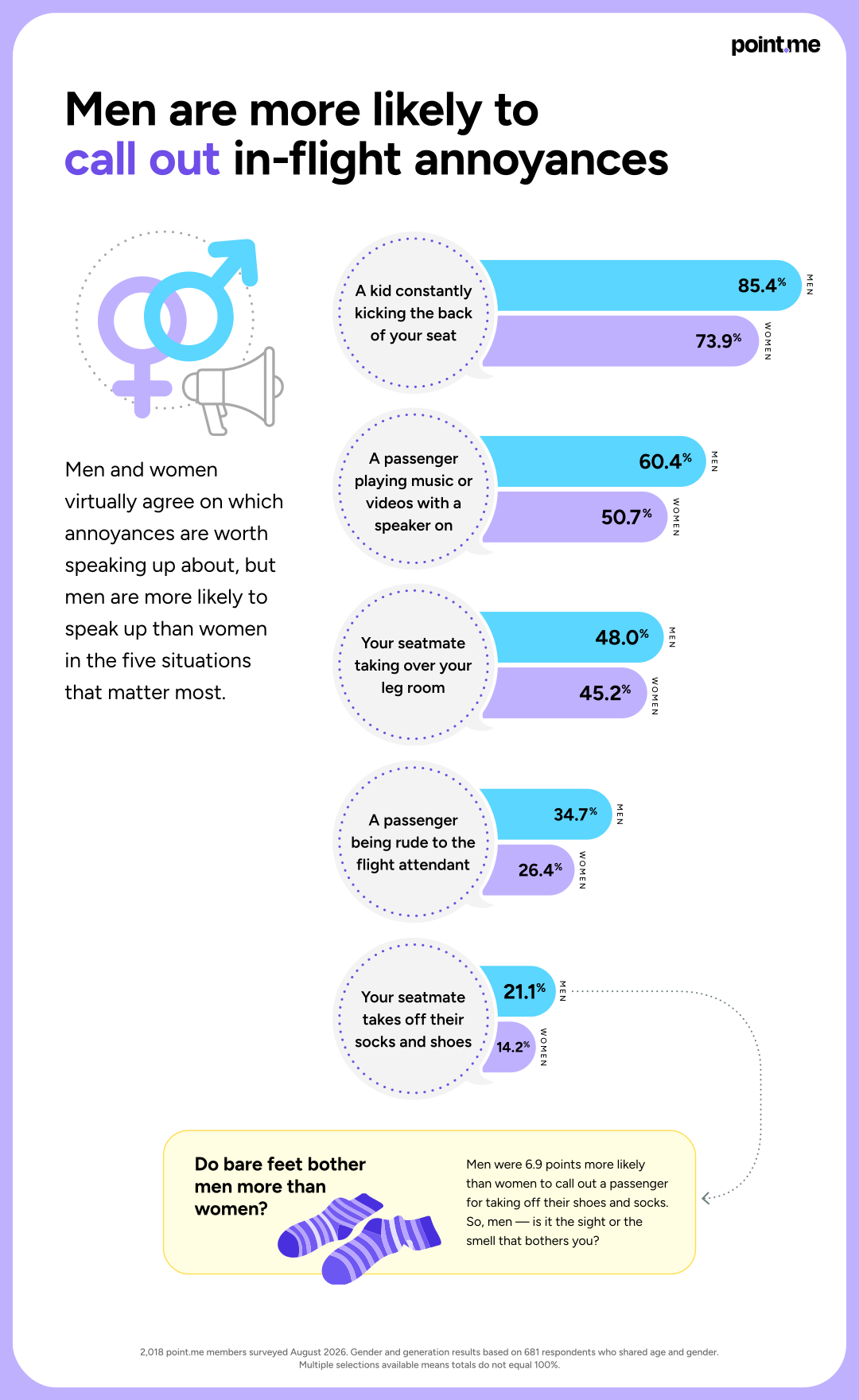
Who's more likely to say something when a cabin annoyance strikes? According to our data, men, just about every time.
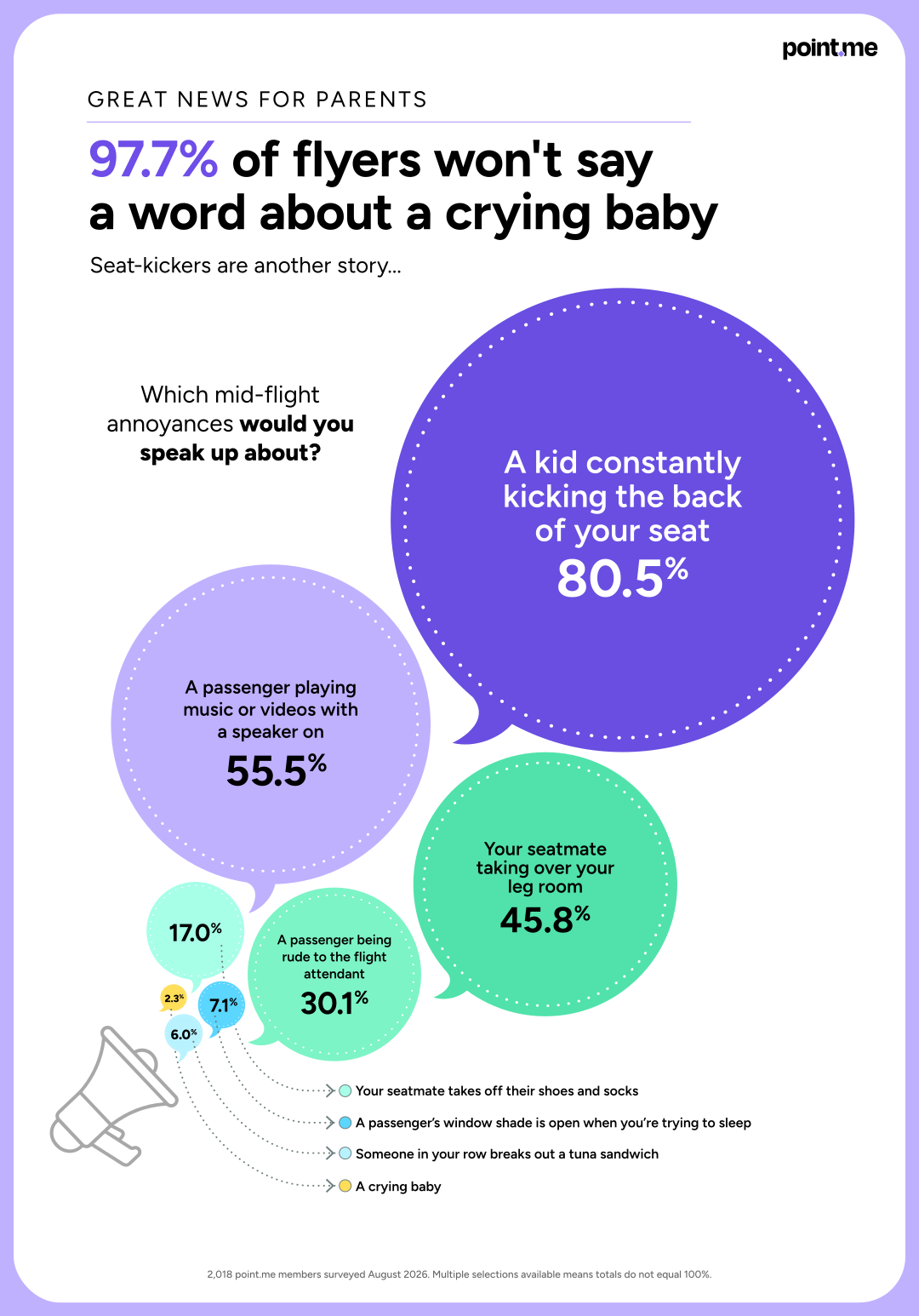
Take the seat-kicking child: 85.4% of men said they'd speak up, compared with 73.9% of women. A passenger listening to music without earphones? 60.4% of men would say something, versus 50.7% of women. And when it comes to someone being rude to a flight attendant, 34.7% of men would step in, compared with 26.4% of women.
Social norms may make some women more cautious about confronting strangers in tight quarters, or more inclined to weigh the risk of an awkward exchange. Whatever the reason, the data suggests a lot of cabin grumbling goes unspoken.

Seat kicking is the breaking point
Good news for parents: the crying baby may not be the menace the internet makes it out to be. Only 2.3% of our respondents said they'd speak up over a bawling infant. One less thing to worry about, parents.
The seat-kicker, though? That's where patience runs out. A whopping 80.5% of respondents said they'd say something if a child was kicking their seat; beating out smelly sandwiches, crying babies and passengers who play audio without earphones.
Seat preferences shift hard based on age and gender
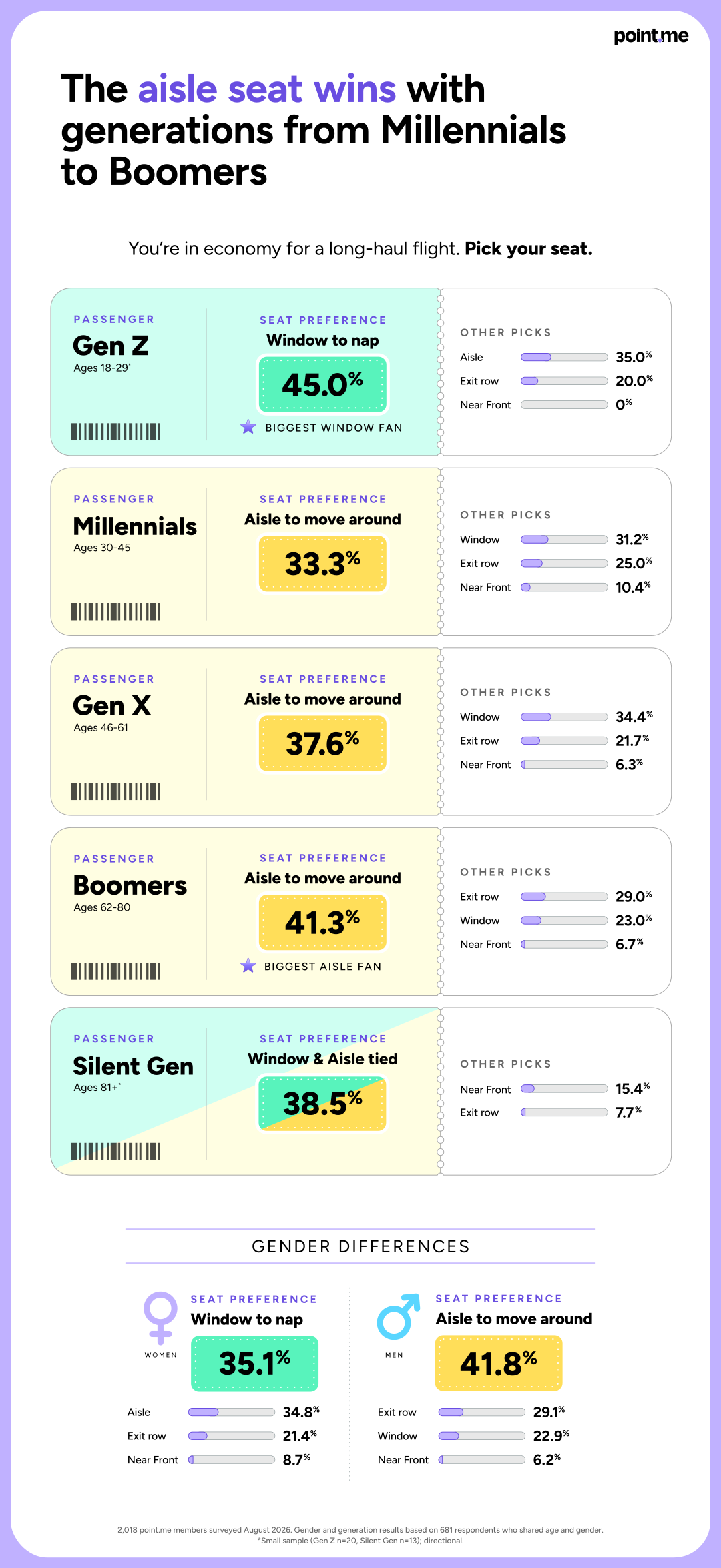
Here's a trend that tracks neatly with life stage: the younger you are, the more likely you are to prefer the window seat. With each older age group, the pull of the window weakens.
Younger fliers may value the window for the view, the wall to lean against, and the freedom to sleep without being bumped by the beverage cart. Older fliers, however, may care more about legroom, easy bathroom trips and not having to climb over a sleeping stranger every time nature calls. Flying more, and for longer, tends to make flexibility a bigger priority than scenery.
Either way, the data suggests that window-seat romance fades.
The seat wars, it turns out, are also the gender wars. Men lean hard into the aisle seat, with 41.8% naming it as their favorite. Women, on the other hand, are more likely to choose the window, at 35.1%.
The worst seat on the plane is by the bathroom
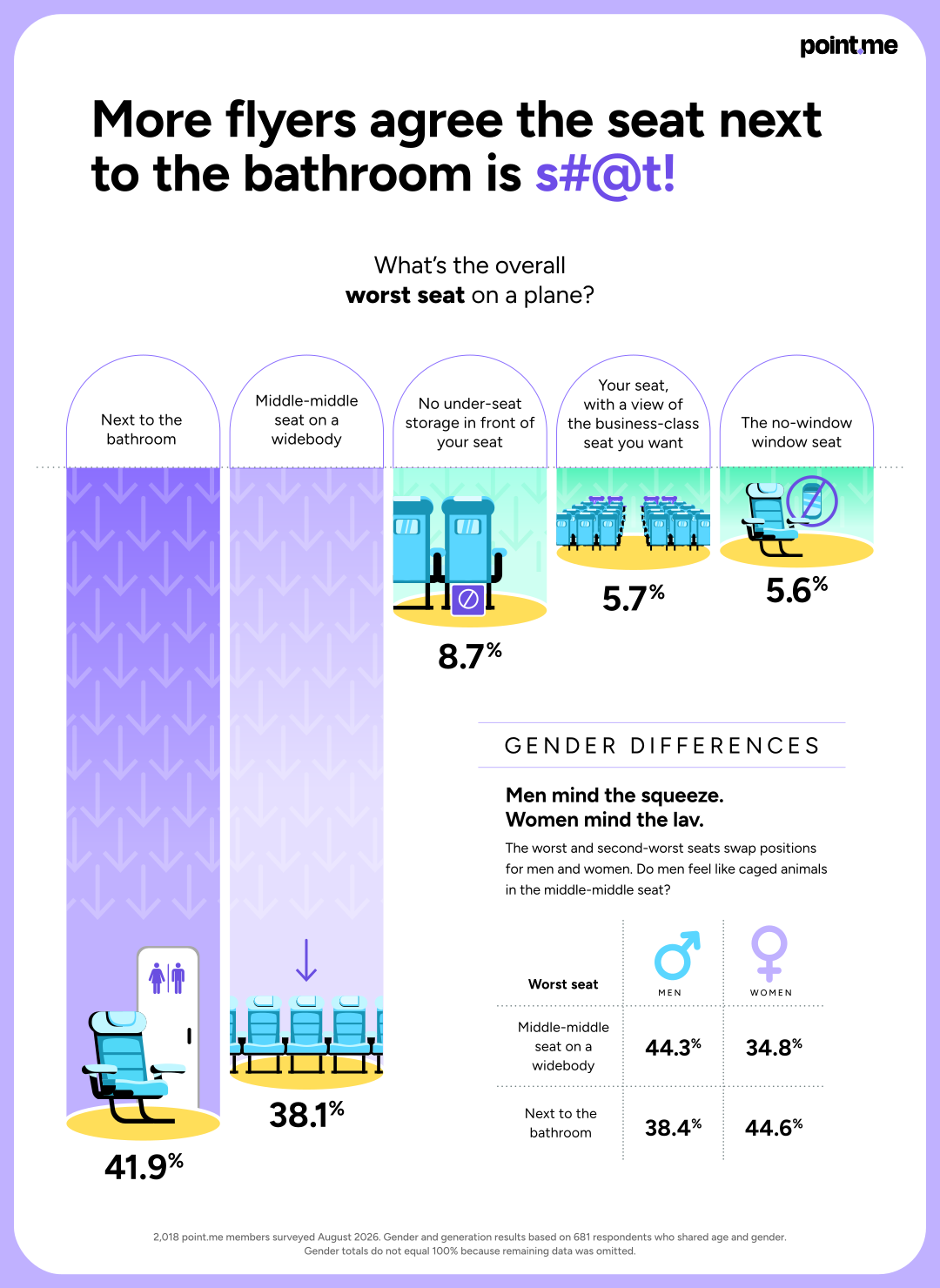
Forget the window-versus-aisle debate. According to our members, the worst seat on the plane is the one next to the lavatory, which 41.9% of respondents named as their least favorite. Think about what that seat comes with: a constant line of people, the endless flushing, the door that never quite latches, and the unmistakable aroma of an aircraft at hour nine.
The middle-middle seat, the scourge of long-haul flights, came in second at 38.1%. No window to lean on, no aisle access, and multiple neighbors on both sides. Plus, being in the middle seat in the middle row means you don’t even have a shot at getting some daylight. It's a lot to endure for 12 hours.
Those two results tell us something: for experienced fliers, the worst seats are less about position than about what they can't control.
Seat swapping is OK… sometimes
Few etiquette questions cause as much angst as the seat-swap request. Our survey found that fliers are willing to help, but they want something in return, or a really good reason.
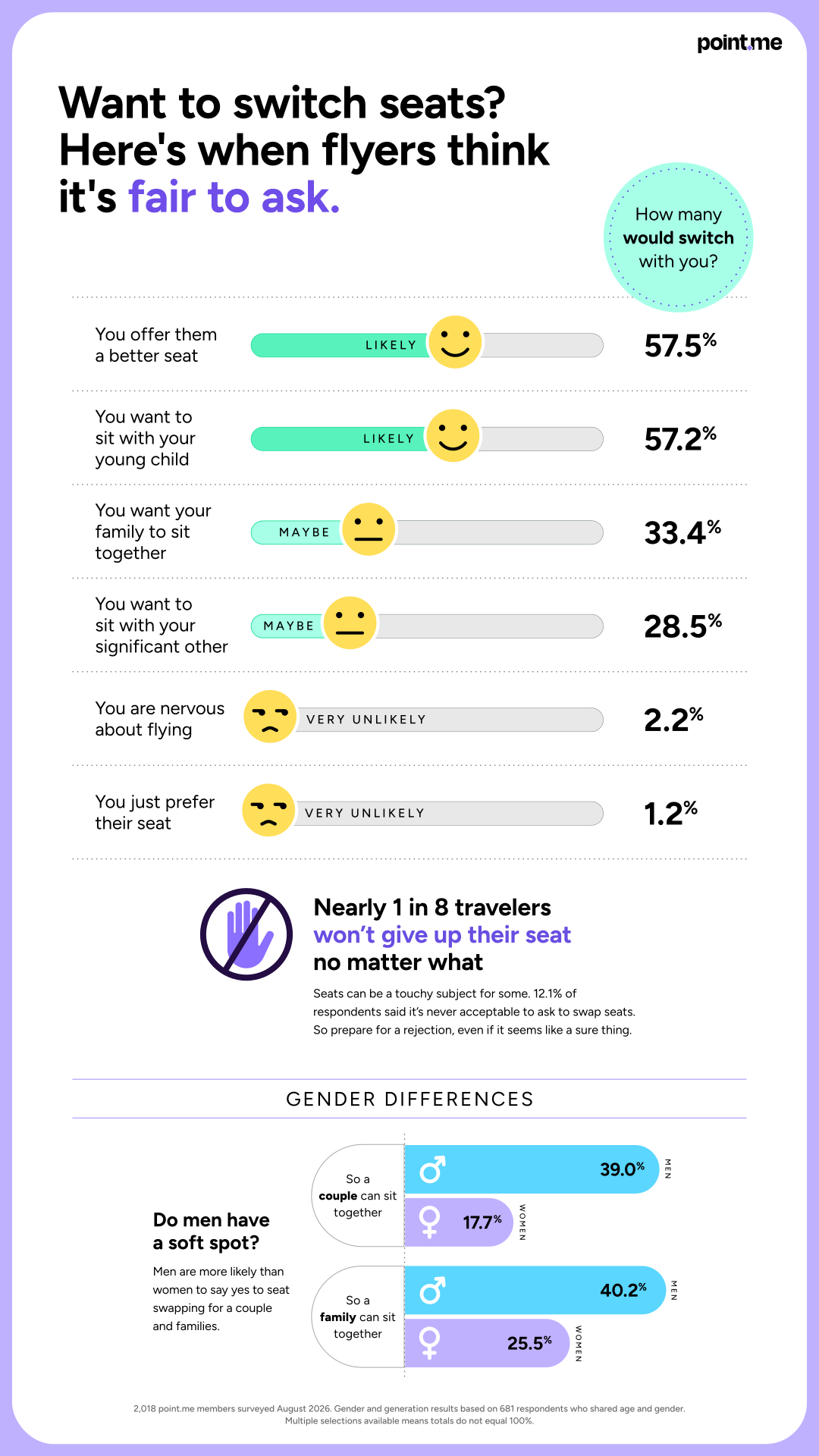
The most popular reason: 57.5% of respondents had no problem switching seats if they got a better seat in the process. (Fair.) Nearly the same number, 57.2%, were happy to switch so that a parent could sit with a young child. (Understandable.)
But sympathy dropped from there. Only 33.4% said they would swap so a family could sit together, and 28.5% would swap to accommodate a couple. A small but adamant 12.1% said it's never acceptable to ask for a swap, for any reason.
Among these responses, however, we did see some interesting differences along gender lines. Nearly twice as many men said it was acceptable for a couple to ask for a swap (39.0% of men vs. 17.7% of women). Men were also 1.6 times more likely to think it was acceptable to ask for a swap to accommodate a family (40.2% of men vs 25.5% of women).
Younger fliers are going no-contact… with the flight attendant
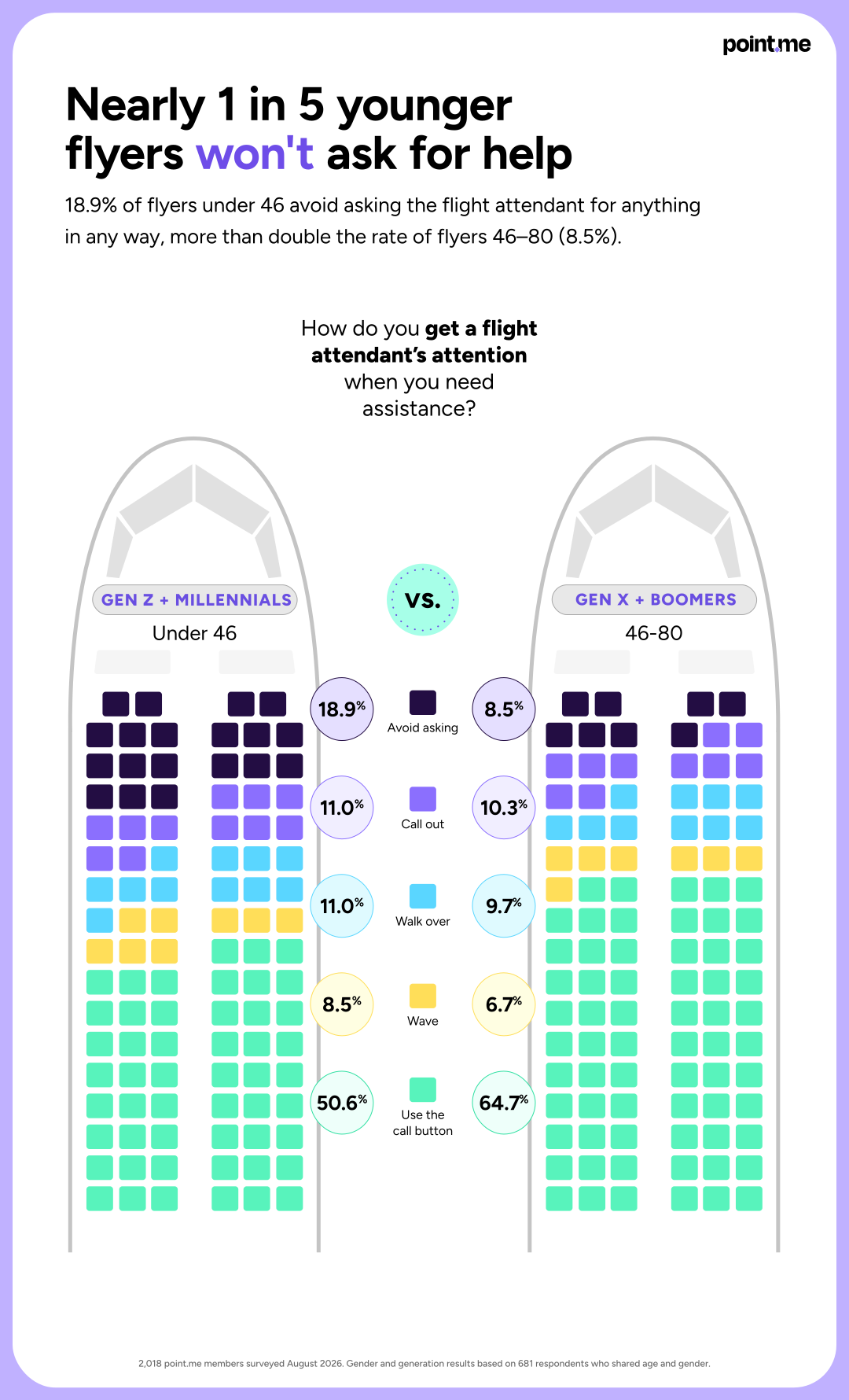
When you need something from the flight attendant, how do you ask? Overall, our respondents were happy to abide by an unspoken cabin rule: the call button is by far the most popular choice, with 62% choosing it as their preferred method of communication. Interestingly, 9.3% of respondents said they simply raise a hand and flag them down, which takes confidence.
But among younger fliers, a different pattern emerged: 18.9% of fliers under the age of 46 said they avoid the flight attendant entirely, nearly twice the rate of their older peers. Instead of pressing the button, they'd prefer to suffer in silence. The other interesting split here was between genders. Women are more likely to avoid the flight attendant at 13.4%, while only 8.6% of men said they tend to keep quiet.
Carry-on separation anxiety is real
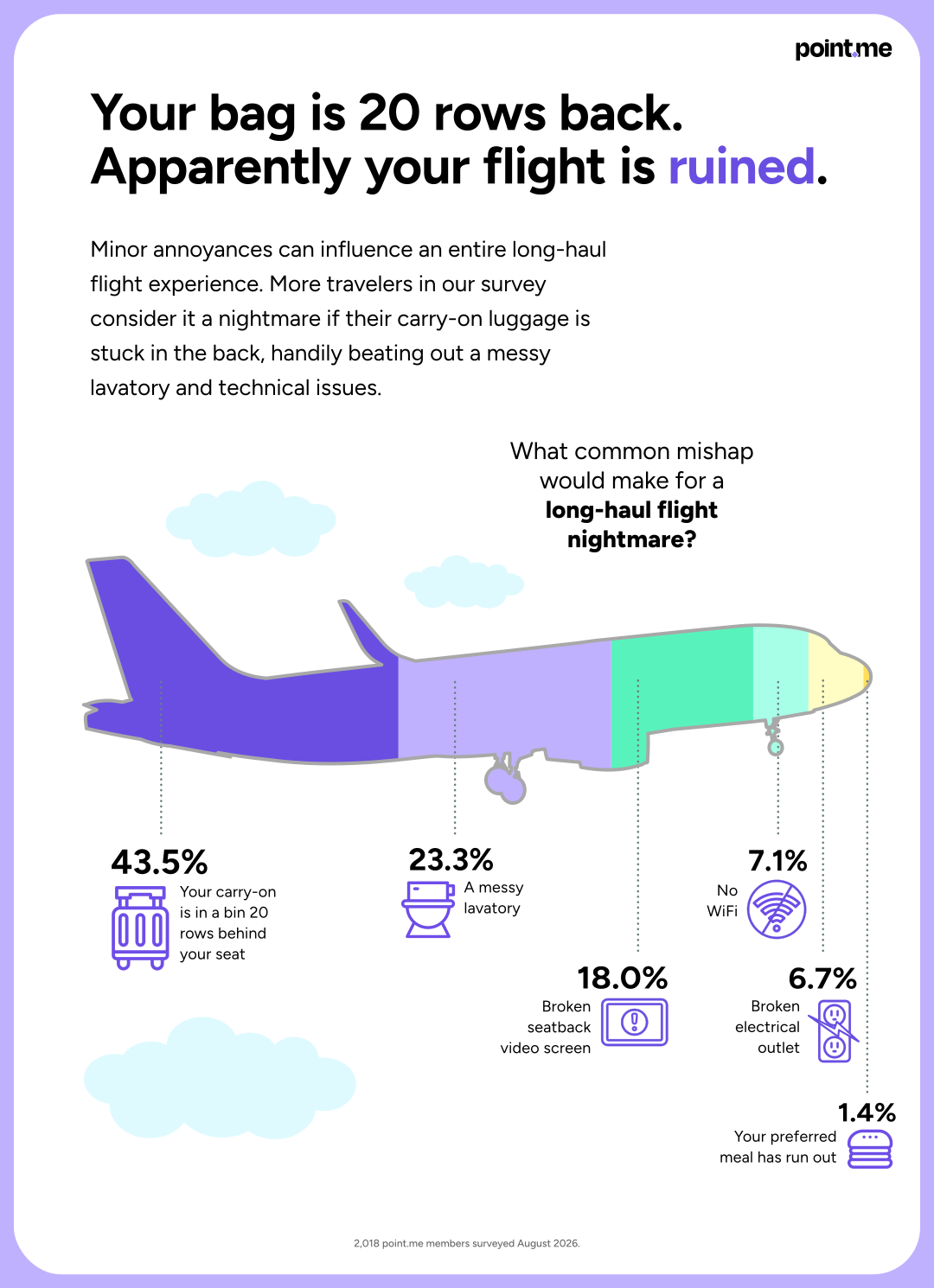
Ask a frequent flier to name the most frustrating in-flight scenario, and their luggage was top-of-mind. For 43.5% of respondents, the most annoying scenario is being forced to stow their carry-on 20 rows behind them.
For travelers who fly often, a carry-on is mission control: noise-canceling headphones, chargers, medications, a change of clothes in case their checked bag goes rogue. Being separated from it, even by a few rows, spells stress.
This beat out other situations like a messy lav (23.3%), broken seatback entertainment (18.0%), no wifi (7.1%), a broken electrical outlet (6.7%), and running out of a preferred meal (1.4%).
The bottom line
Here's what point.me’s members can tell you: the cabin is a tight space, and tolerance is a finite resource – especially this season, when flight interruptions have arrived even before the holiday season. Parents of crying babies can breathe easy. Parents of seat-kickers, take note. And if someone asks you to swap seats, the answer may depend on what's in it for you.
How point.me can help
Better seats start with better flights. point.me searches 150+ airlines and loyalty programs to find award flights, helping members get 6–12x more value from their points than booking through a credit card portal. Trusted by over 2 million travelers, point.me's membership pays for itself with one booking. Start searching for free today →
About this survey
point.me surveyed 2,018 highly experienced travelers, all point.me members: more than half fly five or more times a year, they hold hundreds of thousands of points, and actively transfer credit card points to airline loyalty programs. Collectively, our members hold hundreds of millions of points. This is a credibility-weighted index of in-flight passenger behavior, told by people who spend a lot of time at or above 35,000 feet. Age and gender findings reflect the 681 respondents who provided that detail.
About the author

Laura Motta
Travel & Points Expert
Laura has been writing, editing, and developing online products in the travel space for more than 15 years. The best mistake fare she ever booked was $142 round-trip from JFK to Copenhagen. Check out her newsletter about travel and culture, The Escapologist.